About Me
About Me
I'm Magdalena Siwek, a computational scientist.
I build stochastic models and ML systems for high-dimensional, noisy time-series data, and ship them as production Python. My work spans time-series inference, probabilistic modeling, and ML surrogates for expensive simulations, with HPC experience at ~3M CPU-hour scale. I earned my PhD from Harvard in 2024, and since then I've been a Fellow with the Simons Society of Fellows, first at Columbia and now at New York University, where I built and released calypso — a stochastic time-series emulator that runs ~10³× cheaper at inference than a neural baseline. I remain a full member of the NANOGrav collaboration, and co-develop the population-synthesis code holodeck.
I am originally from Germany, and completed my undergraduate (BSc) and graduate (MSci) studies in physics and astronomy at the University of Glasgow before starting my PhD at Harvard in 2018. I was also a Teaching Fellow at Harvard (2021–22, Bok Center Distinction in Teaching). While at Harvard I founded and ran the CfA's community garden. I am also an avid mushroom hunter.
- Name:Magdalena Siwek
- Focus:Stochastic processes, time-series inference, ML surrogates, HPC
- Current Position:Fellow, Simons Society of Fellows (Columbia & NYU)
- Languages:Python (NumPy, SciPy, PyTorch, Pandas), C, Cython
- Education:
2024 - PhD in Astrophysics, Harvard University
2018 - MSci, University of Glasgow
2017 - BSc, University of Glasgow
Research
Research
calypso — Stochastic Time-Series Emulator
calypso emulates expensive stochastic time series. Instead of running a month-long simulation for every new parameter set, it draws calibrated synthetic realizations in a fraction of a second, anywhere across a 2-D parameter space. A PCA and multivariate-Gaussian sampler replaces a neural baseline at ~10³× lower inference cost, with no hyperparameter tuning and no training instability. Shipped as v1.0 on PyPI with an automated release pipeline and a live demo.
Circumbinary Disk Hydrodynamics
Accretion disks around binary systems (also known as circumbinary disks; CBDs) can range in scale from protoplanetary disks around stellar binaries, up to accretion disks around massive black hole binaries (MBHBs) at the centres of galaxies.
I recently published the largest hydrodynamic parameter study of binaries and accretion disks to date, and use data from this simulation suite to study the orbital evolution of binary systems in CBD systems.
Low-frequency Gravitational Waves (PTAs)
Pulsar Timing Arrays (PTAs) have now found compelling evidence for the existence of a Gravitational Wave Background (GWB): a ‘hum’ of low-frequency gravitational waves that permeates the Universe. In my thesis work I found that CBD accretion can significantly boost the gravitational wave background. I model the MBHB populations that produce the low-frequency GWB detected with PTAs, and quantify the effect of gas dynamics on the GWB spectrum.
Stellar Mass Binaries
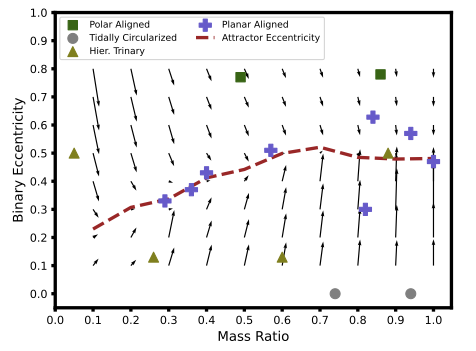
Circumbinary Disks form on all scales, from protoplanetary disks to AGN disks. During the formation of binary stars, the formation of a circumbinary disk may occur. In Siwek+2023b, we found that CBDs drive binary systems to equilibrium eccentricities, which are proportional to the mass ratio of the binary. Evidence for this effect was recently been found in actively accreting stellar binaries! Shown above in Figure 2 from Murray & Duffell (2025).
Magnetic fields in Circumbinary Disks
Most circumbinary disk simulations neglect the presence of magnetic fields, approximating the angular momentum transport with an alpha model. However, whether the alpha model is appropriate in the complex morphology of the CBD is highly uncertain. I am currently expanding my simulations to include self-consistent viscosity modeling by resolving the Magnetorotational Instability (MRI). I will investigate whether this changes the accretion behaviour of the binary and its orbital evolution, and look for electromagnetic transient signals that cannot be modeled with pure hydrodynamics.
Publications
Publications
2026
calypso: a Parameter-Conditioned Stochastic Surrogate Model for Circumbinary Accretion Time-Series
Magdalena Siwek et al.
A fully stochastic, interpretable emulator for expensive high-dimensional time series. A PCA + multivariate-Gaussian sampler interpolates across a 2-D parameter space, returning calibrated realizations at ~10³× lower inference cost than a neural baseline — no hyperparameter tuning, no training instability. Released as calypso-emulator on PyPI with a live Streamlit demo and an automated release pipeline.
October 2024
Signatures of Circumbinary Disk Dynamics in Multi-Messenger Population Studies of Massive Black Hole Binaries
Magdalena Siwek, Luke Zoltan Kelley, Lars Hernquist
In this work, we combine the CBD models from my suite of hydrodynamic simulations and apply it to a MBHB population synthesis model based on galaxy merger rates from the cosmological simulation Illustris. We find that MBHB populations detected in PTAs, LSST and even LISA show a significant (1-2 orders of magnitude) increase in their eccentricity distributions when CBD models are applied. Our results suggest that detections of eccentric MBHBs are the rule rather than the exception in upcoming transient surveys, provided that CBDs regularly form in MBHB systems. This is due to the eccentricity pumping effects found in my simulations. We also find that eccentric harmonics are much more likely to be detected in LISA with the influence of CBD accretion.
June 2023
Orbital Evolution of Binaries in Circumbinary Disks
Magdalena Siwek, Rainer Weinberger, Lars Hernquist
Binaries on many scales encounter circumbinary disk (CBD) driven evolution at some point in their lives. But how does the presence of a CBD affect the orbital elements of the binary? In this work, we ran the largest to-date parameter study over binary mass ratio (q) and eccentricity (e), evaluating how the interaction with the CBD is affected by varying the parameters q and e. We discovered that mass ratio and eccentricity become correlated very quickly in the presence of a CBD, that is, the eccentricity evolves to an equilibrium value that is determined by the mass ratio of the system. I am excited to see whether we can find evidence of this dynamical effect in massive black hole or stellar binary populations.